graphium
Compile-time graph orchestration for Rust.

Repository Details
| Repo #1206174880 | |
|---|---|
| Author | Lorenzo Rottigni |
| Created At | 2026-04-09 |
| Updated At | 2026-05-28 |
| Pushed At | 2026-05-28 |
| Size | 734 MB |
| Main Language | Rust |
| Star count | 1 |
| Default branch | master |
Repository Skills
- #Rust
- #graph
- #proc-macro
- #workflow
README.md
GRAPHIUM

Graphium is a Rust framework for defining observable DAG-based workflows through a declarative, Rust-friendly DSL.
It allows developers to express computation as composable algorithmic graphs, where logic is modeled as directed acyclic graphs (DAGs) and expanded into Rust code at compile time.
The framework focuses on zero-cost abstractions: DSL parsing and graph expansion happen entirely at compile time, and the generated code is further optimized by LLVM.
Runtime behavior is optional and controlled via feature flags. Using Graphium with only the "macros" feature results in near-zero runtime overhead, since all orchestration is resolved at compile time.
Documentation
Start here: crates/core/docs/index.md.
If you want a “full-stack” demo (APIs + dashboard + telemetry), see:
Install
[dependencies]
graphium = { version = "0.1", features = ["macros"] }
Enable additional features (optional): dto, export, playground, metrics, trace, logs.
Why Graphium
- Typed dataflow: values are explicit artifacts flowing between nodes.
- Ownership-aware DSL: owned / borrowed / taken artifacts map to safe Rust semantics.
- Observable (optional): metrics, traces, and logs via OpenTelemetry.
- Tooling-friendly (optional): export DTOs for visualization and UI execution.
Quick taste
Graphium graphs are written as a schema and compiled into Rust code:
use graphium::{graph, node};

#[derive(Default)]
pub struct Context {}

node! { fn get_number() -> u32 { 42 } }
node! { fn duplicate(a: u32) -> (u32, u32) { (a, a) } }
node! { fn pipe(a: u32) -> u32 { a } }

graph! {
    #[metrics("performance", "errors", "count")]
    ExampleGraph<Context> -> (out: u32) {
        GetNumber() -> (number) >>
        Duplicate(number) -> (left, right) >>
        Pipe(left) -> (out)
    }
}
Use cases (low / mid / high level)
Graphium can model workflows at different levels of abstraction:
Low-level (function pipeline)
use graphium::{graph, node};

node! { fn add(a: u32, b: u32) -> u32 { a + b } }
node! { fn pow(a: u32) -> u32 { a * a } }

graph! {
    TransformGraph<graphium::Context>(a: u32, b: u32) -> (out: u32) {
        Add(a, b) -> (c) >>
        Pow(c) -> (out)
    }
}
Mid-level (domain operations + artifacts)
use graphium::{graph, node};

#[derive(Default)]
pub struct Context { pub threshold: u32 }

node! { fn get_threshold(ctx: &Context) -> u32 { ctx.threshold } }
node! { fn compute() -> u32 { 10 } }
node! { fn is_ok(v: u32, threshold: u32) -> bool { v >= threshold } }

graph! {
    RuleGraph<Context> -> (ok: bool) {
        GetThreshold() -> (threshold) >>
        Compute() -> (value) >>
        IsOk(value, threshold) -> (ok)
    }
}
High-level (orchestration + nested graphs)
use graphium::{graph, node};

node! { fn setup_storage() {} }
node! { fn start_http_api() {} }

graph! {
    Platform<graphium::Context> {
        SetupStorage() >>
        StartHttpApi()
    }
}
For in-depth DSL rules and artifact ownership, see crates/core/docs/index.md.
Graphium UI
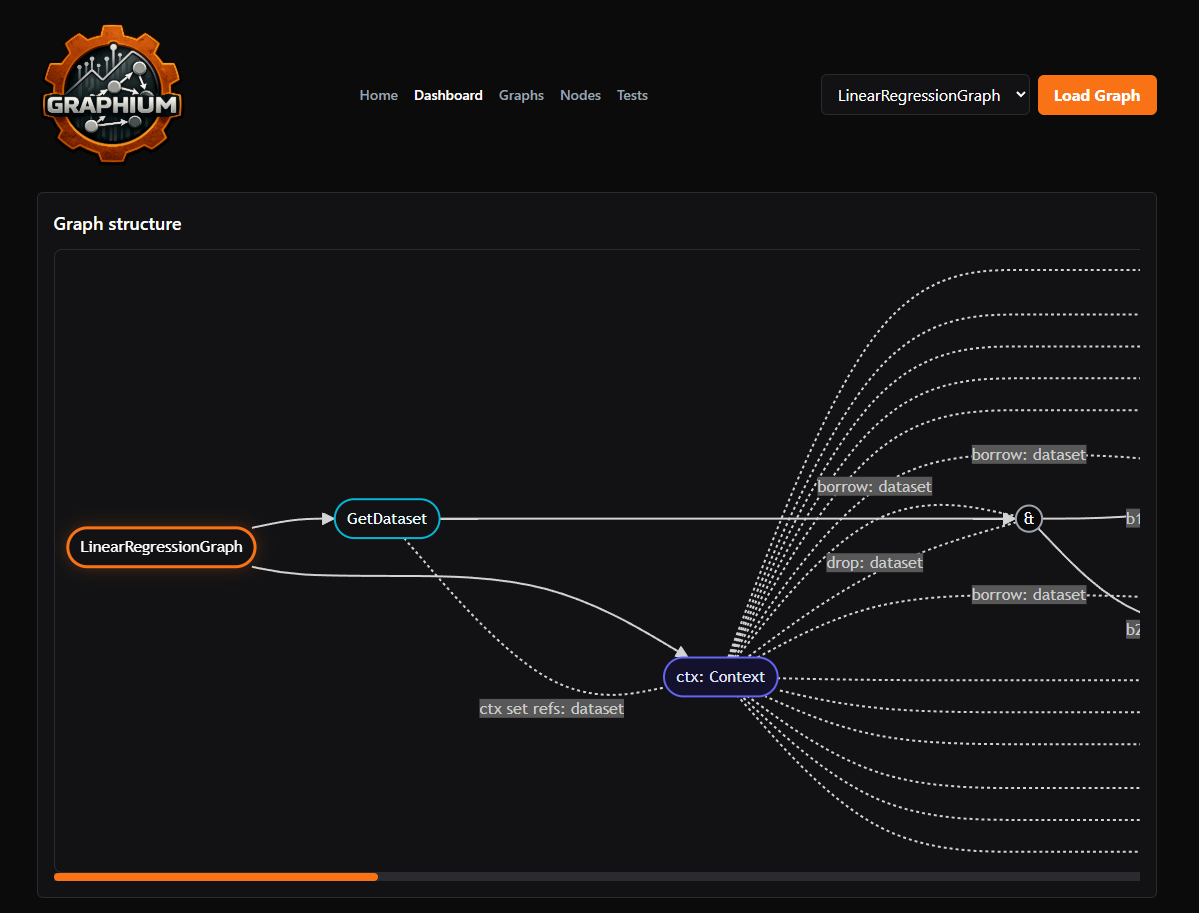
Graphium ships a local UI for visualization, playground execution, and test runs. See crates/ui/README.md.